 Written by
  Edited by

I’m 30 and wondering how much should I contribute to my Roth IRA vs. traditional IRA? What are the pros and cons of each account?
Deciding how to split your savings between Roth and tax-deferred accounts is mostly about comparing your current and future tax rates. But the right mix is not always a simple either-or decision, especially when you have decades for your income, tax laws and retirement goals to change. Other factors, including control over future distributions, can also shape how much you contribute to each type of account.
If you have similar questions about saving for retirement and using Roth accounts, consider working with a financial advisor. Connect with an advisor for free.
Current vs. Future Tax Rates
To the extent that your current tax rate is lower than your future tax rate, it makes more sense to put your savings into Roth accounts. At 30 years old, you likely have 30 or more years until you retire and need to start taking distributions from your account. A lot can change between now and then, including tax laws. Since you can’t know for sure what your future tax rate will be, it’s necessary to estimate it.
One reason younger workers often favor Roth contributions is that they may be in some of the lowest tax brackets they’ll ever experience. Many people earn significantly more in their 40s and 50s than they do at age 30. If that’s likely to be true for you, paying taxes on your contributions now may be preferable to paying them later when withdrawals could be taxed at higher rates.
That said, it’s a mistake to assume your tax rate will automatically decrease in retirement. Some retirees have substantial pension income, large required minimum distributions (RMDs), significant investment income or even part-time employment. In those cases, retirement tax rates can be surprisingly similar to your pre-retirement tax rates.
(And if you need help with tax planning or other parts of your retirement plan, speak with a financial advisor.)
Control Over Distributions
You may also want to contribute more to Roth accounts if control is important to you. If you have money in traditional, tax-deferred accounts, those assets will be subject to RMDs when you reach age 75 (age 73 for people born between 1951 and 1959). That’s not the case for Roth accounts. This gives you more flexibility in your distributions.
That flexibility can matter because taxable withdrawals may affect more than your income tax bill. Traditional IRA distributions can increase taxable income in retirement, which may influence how much of your Social Security is taxed, whether you owe higher Medicare premiums and how much room you have to realize capital gains or make Roth conversions in lower-income years.
Having Roth assets gives you another source of retirement income that may not add to taxable income, assuming withdrawals are qualified. That can make it easier to manage your tax bracket from year to year instead of letting RMDs dictate how much taxable income you recognize.
(Want to talk through your Roth strategy with an expert? This matching tool can help you connect with a fiduciary financial advisor for free.)
Pros and Cons of Traditional vs. Roth IRAs
| Pros of Traditional IRAs | Cons of Traditional IRAs |
|---|---|
| Contributions may be tax deductible | Withdrawals are taxed as ordinary income |
| May benefit higher earners who expect lower retirement taxes | RMDs apply whether you need the money or not |
| Allows more money to compound upfront before taxes | Large balances can create large taxable distributions |
| Available regardless of income, though deductibility may be limited | Future tax rates may be higher than expected |
| Pros of Roth IRAs | Cons of Roth IRAs |
|---|---|
| Qualified withdrawals in retirement are tax-free | No tax deduction on contributions |
| No RMDs during your lifetime | You pay income tax on contributions |
| More flexibility when managing taxes in retirement | Income limitations that restrict who can contribute directly |
| Contributions (but not earnings) can always be withdrawn without taxes or penalties | Early earnings withdrawals may trigger taxes or penalties |
Contributing to Both
Because predicting future tax rates decades in advance is difficult (if not impossible), you may not want to treat this as an all-or-nothing decision. Instead, you can build tax diversification by contributing to both Roth and traditional accounts over time.
Having both types of accounts in retirement can give you more flexibility when managing taxes. For example, you might withdraw enough from traditional accounts to fill up a lower tax bracket and then supplement additional spending needs with tax-free Roth withdrawals.
(And if you need help determining how to split your contributions between different accounts, work with an advisor with retirement planning expertise.)
How Much Should You Contribute?
Whether you contribute to a Roth IRA or a traditional IRA is an important consideration, but it’s also important to consider whether you’re contributing enough in the first place.
At age 30, you have decades of compound growth to work in your favor. If you’re eligible, maximizing your IRA contribution each year can be a good starting point. If you’re unsure whether your future tax rate will be higher or lower, leaning toward Roth contributions at a younger age is often reasonable because many people are still in the earlier stages of their earning careers and may be in lower tax brackets than they’ll be later.
(For more help planning and saving for retirement, consider working with a fiduciary financial advisor.)
Bottom Line
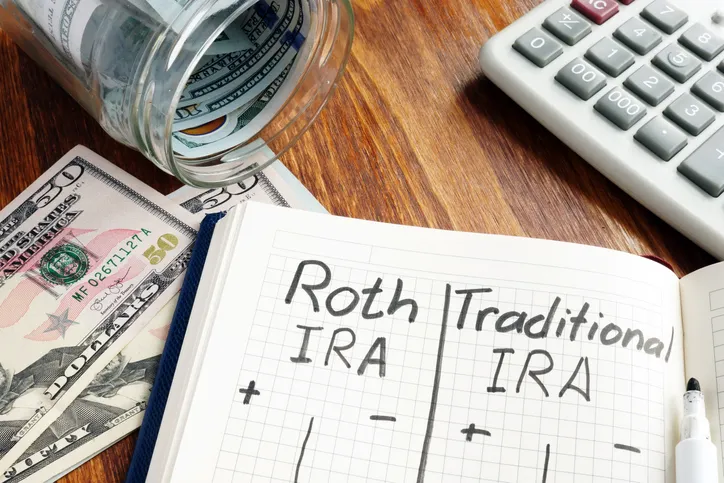
There isn’t a universally correct Roth vs. traditional IRA allocation for a 30-year-old. The decision largely comes down to whether you believe paying taxes now or later will be more advantageous. Since no one can predict future tax rates with certainty, you may want to build flexibility by contributing to both types of accounts.
If you’re 30 and saving consistently, you’re already addressing one of the biggest factors in retirement planning. Saving gives your investments time to compound. Using a mix of Roth and traditional accounts can improve tax efficiency, but consistently contributing and increasing your savings rate as your income grows will likely have a much greater impact on your retirement success.
Retirement Planning Tips
- Retirement planning can require a lot more than simply working toward a specific savings goal. A financial advisor can help you navigate the complexities of this process. Finding a financial advisor doesn’t have to be hard. SmartAsset’s free tool matches you with vetted financial advisors who serve your area, and you can have a free introductory call with your advisor matches to decide which one you feel is right for you. If you’re ready to find an advisor who can help you achieve your financial goals, get started now.
- Years with unusually low income can create opportunities for Roth contributions or Roth conversions. Paying taxes in a lower bracket may be more attractive than waiting until withdrawals are taxed at a higher rate.
Brandon Renfro, CFP®, is a SmartAsset financial planning columnist and answers reader questions on personal finance and tax topics. Got a question you’d like answered? Email AskAnAdvisor@smartasset.com and your question may be answered in a future column.
Please note that Brandon is not an employee of SmartAsset and is not a participant in SmartAsset AMP. He has been compensated for this article. Some reader-submitted questions are edited for clarity or brevity.
Photo credit: ©iStock.com/Photo courtesy of Brandon Renfro, ©iStock.com/designer491