 Written by
  Edited by
  Edited by
  Reviewed by

Before 2020, you could adjust the number of allowances on your W-4. This allowed you to change how much federal income tax was withheld from each paycheck depending on your situation. The newer, simpler W-4 no longer uses allowances but there are some key details about withholding you should know.
A financial advisor may be able to help you create tax strategy based on your income and assets.
What You Should Know About Tax Withholding
Whenever you get paid, your employer removes, or withholds, a certain amount of money from your paycheck to cover taxes. So instead of paying one lump sum during tax season, you pay them gradually throughout the year. Employers in every state must withhold money for federal income taxes. Some states, cities, and other municipal governments also require income tax withholding.
Pay-as-you-go taxes also apply to pension income and other earnings such as gambling winnings, bonuses or commissions. If you’re a business owner, independent contractor or otherwise self-employed, it gets more complicated. You’ll need to set aside money for taxes yourself. You’ll also likely have to make quarterly estimated tax payments to cover what you owe.
Exactly how much your employer withholds will depends on two factor. It will base withholdings on how much money you make and how you fill out your W-4. While you used to be able to claim allowances, your withholding is now affected by your claimed dependents, if your spouse works, or if you have multiple jobs. You can also list deductions and other withholdings.
When you fill out your W-4, you are telling your employer how much to withhold from your pay. That’s why you need to fill out a new W-4 periodically. Typically it happens when you start a new job or experience a big life change like marriage or children.
What Were Tax Allowances?

A withholding allowance was like an exemption from having a certain amount of income tax kept back from your pay. So if you claimed an allowance, you believed that you qualified to have less taxes withheld. The W-4 communicated this to your employer and to the government. Should you have claimed zero allowances on your W-4, your employer would have withheld the maximum amount possible.
If you didn’t claim enough allowances, you overpaid your taxes throughout the year. This typically results with a tax refund come tax season. If you claimed too many allowances, you probably ended up owing the IRS money.
How Did You Determine How Many Allowances You Should Claim?
Allowances are no longer in effect on the current W-4 form, but when they were, the allowances were completely subjective. Many people would take an allowance for every single person that they were responsible for financially. So if you had yourself, a spouse and two children, you may claim four allowances.
Ultimately, the number of allowances depended on your tax strategy and whether you needed to take more tax out of your check or you needed more monthly income. It was a very personal choice with no exact answer.
How Do I Affect Withholding Now?
In 2020, the IRS redesigned the W-4 and removed the allowance system. 1 Although the change was intended to simplify the form, many filers find the new version more complex, and it now relies on different inputs to determine how much tax is withheld from each paycheck.
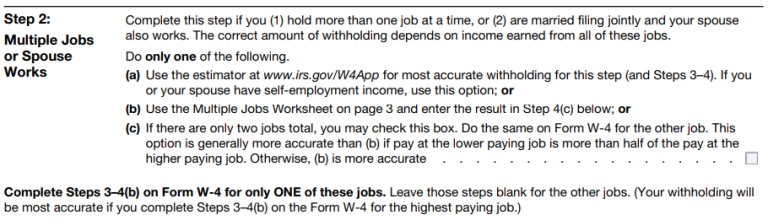
First, it’s important to fill out the multiple jobs or working spouse section using the worksheet on the third page of the W-4 to properly estimate your annual household income.
Second, the total number of dependents you claim also has a significant effect on your total withholding, so make sure you claim the correct number of dependents in Step 3.

Section 4 of the W-4 lets you account for other income, deductions and any additional federal income tax you want withheld from each paycheck. The 2026 form also includes a deductions worksheet that reflects deductions available under current federal tax law.

If you have a complex tax situation, it may be wise to work with a financial advisor who specializes in tax planning.
Claiming an Exemption From Withholding
If the IRS refunded you last year for all of the federal income tax you withheld, and if you expect that to happen again this year, you can claim an exemption from withholding. Generally, you can claim exemption from federal tax withholdings if both of the following are true:
- You had no tax liability in the previous tax year
- You expect to have no tax liability in the current tax year
Keep in mind that this exemption only applies to federal income tax. You still need to pay the FICA taxes for Social Security and Medicare.
Fine-Tuning Your Withholdings
You can claim deductions and extra withholding as you so desire. Taking an estimated or inaccurate amount would mean you overpay or underpay your taxes, but you can do it. You may want to claim different amounts to change the size of your paychecks. This is a personal choice that helps you plan your budget throughout the year.
At the same time, you can submit a new W-4 at any time during the year. So if you decide that you want larger or smaller paychecks, you can submit a new W-4 to your employer with a different number of deductions or withholdings.
When to Update Your W-4
Filing a W-4 isn’t a one-time event. Certain life changes and financial decisions can significantly impact your tax liability and paycheck. To keep your withholding accurate, consider updating your W-4 when any of the following events occur:
- Marriage or divorce
- Having or adopting a child
- A spouse starting or leaving a job
- Starting a second job or side income
- A significant change in income or bonuses
Buying a home and becoming eligible for itemized deductions - No longer being eligible to claim a dependent
Updating your W-4 after any of these changes can help avoid under- or over-withholding. This can reduce the risk of owing money to the IRS. You can submit a new W-4 to your employer at any time, and it usually takes effect within a few pay periods.
What If You Still Have an Old W-4 With Allowances?
Employees who gave an employer a valid W-4 before 2020 generally do not have to submit a new form solely because the IRS eliminated allowances from newer versions. Employers can continue calculating withholding using an older W-4 until the employee submits a replacement.
That means allowances can still affect some workers’ withholding in 2026 even though employees can no longer claim allowances on a new W-4. For example, an employee who has remained with the same employer since 2019 and has never replaced the W-4 on file could still have withholding calculated using the allowances claimed on that form.
Once the employee submits a current W-4, however, withholding is calculated under the newer system. The employee provides filing status and, when applicable, information about multiple jobs, credits, other income, deductions and additional withholding instead of choosing a number of allowances.
How Tax Law Changes Affect Withholding in 2026
Federal tax law changes that took effect in 2025 can affect how much tax your employer withholds from your paycheck. Withholding is tied to your expected taxable income, so updates to tax brackets, deductions, and credits can change the amount withheld, even if your income does not change.
Several provisions of the One Big Beautiful Bill Act can reduce taxable income. These include the new senior bonus deduction of up to $6,000 per filer age 65 or older with income below $75,000 for single filers or $150,000 for joint filers. The deduction applies from 2025 through 2028. You can claim it whether you itemize or take the standard deduction. The deduction begins to phase out above those modified adjusted gross income thresholds, so eligibility is not limited to taxpayers whose income falls below them. If you qualify for this deduction and do not update your W-4, your employer may withhold more tax than needed. 2
Estimate your tax liability based on your income and filing status using our calculator.
Standard deductions also increased in 2026 under the law. For example, the standard deduction rose to $16,100 for single filers, $32,200 for married couples filing jointly and $24,150 for heads of household. In addition, the TCJA brackets of 10%, 12%, 22%, 24%, 32%, 35% and 37% remain in place for 2026 and future years, with thresholds adjusted for inflation. These updates can change your withholding once they take effect. 3
Because withholding now reflects dependents, multiple jobs and expected deductions rather than allowances, reviewing your W-4 after the 2025 and 2026 rule changes can help keep your paycheck and tax bill aligned. The IRS withholding estimator or a tax professional can help you calculate the amount to withhold if your situation becomes more complex.
Bottom Line

Tax allowances were an important part of helping people manage their personal finances. While they don’t exist on the W-4 anymore, claiming additional withholding or deductions can still help provide a bigger paycheck. If you’re concerned about the amount your employer withholds, you can also refer to the withholding calculator provided by the IRS or update your W-4 at any time.
Tax Filing Tips
- Some financial advisors are tax experts and can help you understand how taxes impact your financial plan. Finding a financial advisor doesn’t have to be hard. SmartAsset’s free tool matches you with vetted financial advisors who serve your area, and you can have a free introductory call with your advisor matches to decide which one you feel is right for you. If you’re ready to find an advisor who can help you achieve your financial goals, get started now.
- You’ll save time if you gather and organize all the supporting documents required to file your taxes. This means your W-2 or 1099s, student loan interest information, and a slew of other documents, depending on your financial situation. You might also use our tax calculator to get an estimate of what you’ll pay in income taxes.
Photo credit: ©iStock.com/vgajic, ©iStock.com/nandyphotos, IRS W-4 screenshots, ©iStock.com/Steve Debenport
Article Sources
All articles are reviewed and updated by SmartAsset’s fact-checkers for accuracy. Visit our Editorial Policy for more details on our overall journalistic standards.
- “FAQs on the 2020 Form W-4 | Internal Revenue Service.” Home, https://www.irs.gov/newsroom/faqs-on-the-2020-form-w-4. Accessed Sept. 24, 2026.
- “Check Your Eligibility for the New Enhanced Deduction for Seniors | Internal Revenue Service.” Home, https://www.irs.gov/newsroom/check-your-eligibility-for-the-new-enhanced-deduction-for-seniors. Accessed Sept. 24, 2026.
- “IRS Releases Tax Inflation Adjustments for Tax Year 2026, Including Amendments from the One, Big, Beautiful Bill | Internal Revenue Service.” Home, https://www.irs.gov/newsroom/irs-releases-tax-inflation-adjustments-for-tax-year-2026-including-amendments-from-the-one-big-beautiful-bill. Accessed Sept. 24, 2026.