 Written by
  Edited by
  Edited by

Whether you’re a business owner who relies on independent contractors or you make your living as a freelancer, understanding the difference between Form 1099-MISC and 1099-NEC is critical to ensuring tax season runs smoothly. While Form 1099-MISC is used to report payments that aren’t subject to self-employment tax, 1099-NEC reports non-employee compensation.
A financial advisor may be able to help optimize your tax strategy as part of a comprehensive financial plan.
What Is Form 1099-MISC?
Form 1099-MISC is an IRS tax form used to report certain types of income paid to individuals or businesses who are not employees. It’s typically issued by businesses to contractors, vendors or other recipients who received qualifying payments during the tax year. The form helps the IRS track income that may not be subject to traditional payroll withholding.
Historically, Form 1099-MISC was used to report a wide range of nonemployee compensation. However, beginning in 2020, the IRS shifted most nonemployee compensation reporting to Form 1099-NEC. Today, Form 1099-MISC is mainly used for other miscellaneous income types, such as rent, royalties and certain prizes or awards.
Common payments reported on Form 1099-MISC include rental income, royalty payments above a specified threshold and payments to attorneys in some cases. It may also be used to report payments for medical and health care services or other income not covered by Form 1099-NEC. Businesses must provide a copy of the form to the recipient and file it with the IRS by the required deadline.
What Is Form 1099-NEC?
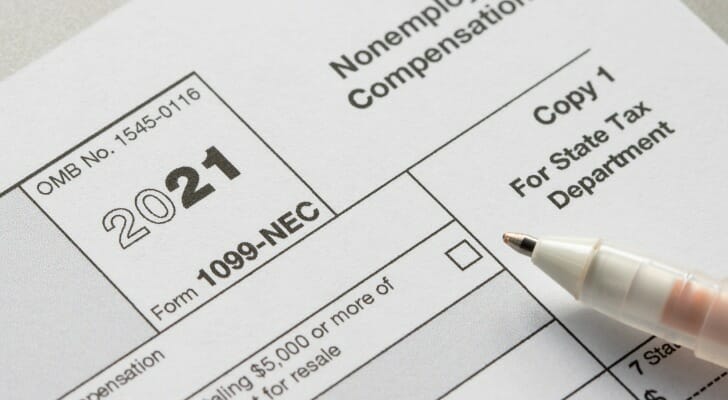
Businesses use IRS Form 1099-NEC to report $600 or more in non-employee compensation (NEC). Generally, these contractor payments go to a person who is subject to self-employment tax. The IRS says this means either payments for services to someone who is not your employee or payments to an attorney. Specifically, these could include payments to a freelance graphic designer or a writer who completes a project or assignment.
Prior to 2020, this kind of payment was reported on Form 1099-MISC. However, the IRS revised its forms in 2020 and separated payments to self-employed contractors on its own form, which became Form 1099-NEC.
How to File Form 1099-NEC
When filing Form 1099-NEC, there will be a Copy A and a Copy B. Copy A is only for informational purposes and should not be printed and filed, according to the IRS. Only Copy B should be printed (if desired) and filed. Copy B can be sent to the contractor for their records, but it is the responsibility of the one making the payments to fill out and file Copy B.
Form 1099-NEC only has one filing deadline, which is Jan. 31. If you’re a freelancer or independent contractor, you should receive your 1099-NEC by this date. Unlike Form 1099-MISC, there are no separate deadlines when filing by paper or electronically.
Required Information on Form 1099-MISC and Form 1099-NEC
When filling out Form 1099-MISC and Form 1099-NEC, make sure you have the right information for both you and the one who received the payment. You can find relevant information on the employee’s W-9. Businesses are required to collect this from each independent contractor with whom they work, so you might already have it on hand.
Once you have the necessary information, be sure to fill in the following on Form 1099-MISC and Form 1099-NEC:
- Payee’s name: The form must include the payee’s name. This could be the name of the individual or a business.
- Payee type: Here is where you will indicate whether the payee is a person, a business, a corporation, etc.
- Address: Here, you will include the payee’s mailing address.
- Tax ID: If applicable, include the payee’s taxpayer identification number.
Who Needs to File Form 1099?
Form 1099, whether it’s 1099-MISC or 1099-NEC, is not required in all situations. But if you have made $600 or more in miscellaneous payments or payments to contractors, you’ll need to take the following steps:
- Make a qualifying reimbursement: For example, you might have paid $600 or more to a contractor during the year, or maybe you paid rent.
- Collect Form W-9: Any time you establish a relationship with an independent contractor, you should collect Form W-9 from them.
- Complete Form 1099-MISC or Form 1099-NEC: As tax time approaches, be sure to fill out the relevant forms as needed. Remember to file before the deadline.
- Submit tax documents: Once you have properly documented any miscellaneous payments or payments to contractors, you are ready to file your own tax documents.
Bottom Line
Understanding the difference between Form 1099-MISC and Form 1099-NEC is essential for accurate income reporting and IRS compliance. While 1099-NEC is now used for most non-employee compensation, 1099-MISC still plays an important role in reporting other types of miscellaneous income such as rent and royalties. Using the correct form helps businesses avoid penalties and ensures recipients report income properly. When the reporting rules feel unclear, a tax professional can help confirm which form applies and how the income should be reported.
Tips for Tax Filing
- A financial advisor can help optimize your tax strategy for your financial goals. Finding a financial advisor doesn’t have to be hard. SmartAsset’s free tool matches you with vetted financial advisors who serve your area, and you can have a free introductory call with your advisor matches to decide which one you feel is right for you. If you’re ready to find an advisor who can help you achieve your financial goals, get started now.
- When the tax code changes, it’s a good idea to use a good tax filing service. We did our annual roundup of the best tax filing software so that you can get through this tax season as painlessly as possible.
- If you want to see whether you’ll get a tax refund or have to pay a tax bill, SmartAsset’s tax return calculator can help you plan ahead.
Photo credit: ©iStock.com/MStudioImages, ©iStock.com/hapabapa, ©iStock.com/TheCrimsonRibbon