 Written by

The Maryland estate tax applies to estates worth more than $5 million. If you live in Maryland and are thinking about estate planning, this guide will walk you through what you need to know about the Maryland estate tax. If you need help with planning, consider working with a financial advisor by using SmartAsset’s free advisor matching tool.
Maryland Estate Tax Exemption
The estate tax is a tax some states and the federal government levy on the estates of wealthy people after they die but before the money is given to their heirs. It is sometimes called the “death tax.”
Don’t confuse the estate tax with the inheritance tax, which is a separate tax some states levy on recipients of an inheritance after it has been passed on.
The Maryland estate tax threshold for 2026 is $5 million, and has been since 2019. This means that if you die and your total estate is worth less than $5 million, the estate owes nothing at all to the state of Maryland. If your estate is worth more than $5 million, though, there is a progressive tax rate for all wealth above that amount that your estate will have to pay before money can be distributed dispersed to your heirs.
Maryland Estate Tax Rate
The estate tax rate for Maryland is graduated. In order to determine your Maryland estate tax burden, start by finding your taxable estate bracket on the chart below. The second column shows what the estate owes on money that falls below your bracket. Then figure out how much of your estate falls above the lower limit of your bracket. Multiply that number by the marginal rate, add it to the base rate and you’ll know the estate tax burden.
Here’s an example: Let’s say your total estate is worth $6.5 million. Subtracting the $5 million exemption, leaves a taxable estate of $1.5 million. Next, find where that number falls on the chart. The base taxes paid for the bracket is $38,800. The bottom of the threshold is $1.04 million, so we subtract that from $1.5 million and get $460,000. That figure multiplied by the marginal rate of 6.4% is $29,440. When we add that number to the base taxes paid, we get a total Maryland estate tax of $68,240 on a $65.5 million estate.
Note: The chart below shows no taxes owed on the first $40,000 of the taxable estate income because of a system of tax credits from the state.
Maryland Estate Tax Rates
| Taxable Estate* | Base Taxes Paid | Marginal Rate | Rate Threshold** |
|---|---|---|---|
| $0 – $40,000 | $0 | 0% | $0 |
| $40,000 – $90,000 | $0 | 0.8% | $40,000 |
| $90,000 – $140,000 | $400 | 1.6% | $90,000 |
| $140,000 – $240,000 | $1,200 | 2.4% | $140,000 |
| $240,000 – $440,000 | $3,600 | 3.2% | $240,000 |
| $440,000 – $640,000 | $10,000 | 4.0% | $440,000 |
| $640,000 – $840,000 | $18,000 | 4.8% | $6400,000 |
| $840,000 – $1.04 million | $27,600 | 5.6% | $840,000 |
| $1.04 million – $1.54 million | $38,800 | 6.4% | $1.04 million |
| $1.54 million – $2.04 million | $70,800 | 7.2% | $1.54 million |
| $2.04 million – $2.54 million | $106,800 | 8% | $2.04 million |
| $2.54 million – $3.04 million | $146,800 | 8.8% | $2.54 million |
| $3.04 million – $3.54 million | $190,800 | 9.6% | $3.04 million |
| $3.54 million – $4.04 million | $238,800 | 10.4% | $3.54 million |
| $4.04 million – $5.04 million | $290,800 | 11.2% | $4.04 million |
| $5.04 million – $6.04 million | $402,800 | 12% | $5.04 million |
| $6.04 million – $7.04 million | $522,800 | 12.8% | $6.04 million |
| $7.04 million – $8.04 million | $650,800 | 13.6% | $7.04 million |
| $8.04 million – $9.04 million | $786,800 | 14.4% | $8.04 million |
| $9.04 million – $10.04 million | $903,800 | 15.2% | $9.04 million |
| $10.04 million and up | $1,082,800 | 16% | $10.04 million |
*The taxable estate is the total above the 2026 exemption of $5 million.
**The rate threshold is the point at which the marginal estate tax rate goes into effect.
Maryland Inheritance Tax
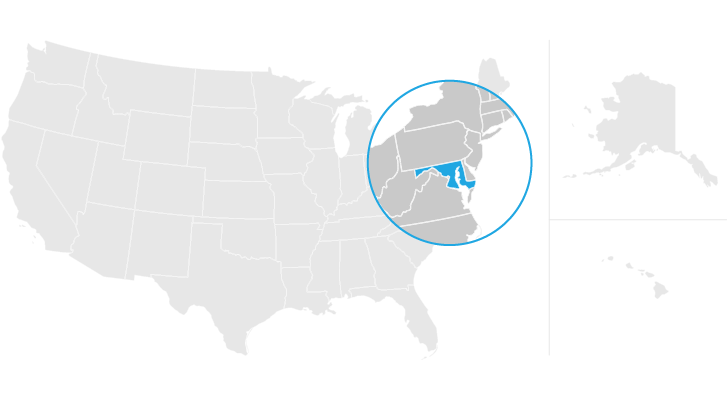
Maryland also has an inheritance tax. If the inheritor is the deceased’s child or direct descendent, the spouse of a child or direct descendent, a spouse, parent, grandparent, sibling, stepchild or stepparent, the inheritance tax does not apply. If money is left to anyone else, there is a 10% Maryland inheritance tax.
Maryland Gift Tax
Maryland does not have a gift tax. The federal gift tax exemption is $19,000 in 2026, the same as for 2025. A gift to one person worth more than that in a single year counts against your 2026 lifetime exemption of $15 million.
Maryland Estate Tax for Married Couples
The Maryland estate tax is portable, meaning that a married couple can protect up to $10 million when both spouses die. However, the personal representative of the deceased spouse’s estate must file a Maryland Estate Tax Return and make the portability election within nine months of the first spouse’s death. The exception is if the two-year grace period for portability-only filings applies, per the Comptroller of Maryland. 1
Federal Estate Tax
There is also a federal estate tax that may apply, but it has a much higher exemption. The federal estate tax exemption is $15 million for deaths in 2026, up from $13.99 million for deaths in 2025. It is also portable. This means spouses can both take advantage of it, meaning married couples can protect from taxes up to $30 million, as of 2026.
If an estate exceeds that amount, the tax rates range from 18% to 40%. A full chart of federal estate tax rates is below. You can use the same method described in the Maryland Estate Tax section to figure out the federal estate tax burden based on the table below.
Federal Estate Tax Rates
| Taxable Estate* | Base Taxes Paid | Marginal Rate | Rate Threshold** |
|---|---|---|---|
| $1 – $10,000 | $0 | 18% | $1 |
| $10,000 – $20,000 | $1,800 | 20% | $10,000 |
| $20,000 – $40,000 | $3,800 | 22% | $20,000 |
| $40,000 – $60,000 | $8,200 | 24% | $40,000 |
| $60,000 – $80,000 | $13,000 | 26% | $60,000 |
| $80,000 – $100,000 | $18,200 | 28% | $80,000 |
| $100,000 – $150,000 | $23,800 | 30% | $100,000 |
| $150,000 – $250,000 | $38,800 | 32% | $150,000 |
| $250,000 – $500,000 | $70,800 | 34% | $250,000 |
| $500,000 – $750,000 | $155,800 | 37% | $500,000 |
| $750,000 – $1 million | $248,300 | 39% | $750,000 |
| Over $1 million | $345,800 | 40% | $1 million |
*The taxable estate is the total above the 2026 exemption of $15 million.
**The rate threshold is the point at which the marginal estate tax rate kicks in.
Overall Maryland Tax Picture
Maryland is moderately tax-friendly for retirees. Social Security is not taxed but other retirement income is. Maryland’s income tax rates ranges from 2% to 6.5%. Additionally, it is one of a few states in the nation where local governments can levy their own income tax. If you’re new to Maryland or have a new job, you can figure out what your take home pay will be, using our Maryland paycheck calculator.
The average effective property tax rate in Maryland is 0.95%. That’s around the national average, but home values in Maryland do tend to be higher.
How a Financial Advisor Can Help With Maryland Estate Tax Planning
Maryland is one of the few states that imposes both an estate tax and an inheritance tax, which creates planning considerations that don’t exist in most other states. A financial advisor working alongside an estate planning attorney can help you navigate both layers of tax exposure and identify strategies to reduce what your estate or heirs ultimately owe.
Assessing Combined Estate and Inheritance Tax Exposure
- What an advisor can do: Review your full estate, including who is named to inherit specific assets, since Maryland’s inheritance tax applies differently depending on the beneficiary’s relationship to you, separate from the estate tax that applies based on total estate value.
- Example: A widower in Annapolis plans to leave a portion of his estate to a close friend rather than a relative. An advisor flags that this gift will trigger Maryland’s 10% inheritance tax, since friends are not among the exempt relationships, and discusses whether restructuring the gift or using other planning tools could reduce that specific tax impact.
Taking Advantage of Maryland’s Portable Exemption
- What an advisor can do: Work with an estate attorney to ensure a married couple’s estate plan properly elects portability so the surviving spouse can use both spouses’ $5 million exemptions, protecting up to $10 million combined.
- Example: A married couple in Bethesda has a combined estate of $8 million. An advisor confirms their estate plan includes the necessary portability election so that when the first spouse dies, the unused portion of their exemption transfers to the surviving spouse, protecting the full $10 million rather than leaving the second spouse with only a single $5 million exemption.
Coordinating Lifetime Gifting to Reduce Maryland Estate Tax Exposure
- What an advisor can do: Build a gifting plan using the federal annual exclusion of $19,000 per recipient in 2026 to reduce the size of a taxable estate over time, since Maryland has no separate gift tax that would limit this strategy at the state level.
- Example: A business owner in Howard County has an estate valued at $6.5 million, putting it above the Maryland threshold. An advisor models a multi-year gifting strategy that transfers assets to children gradually, reducing the taxable estate closer to or below $5 million while the owner retains sufficient assets for retirement.
Modeling Combined Maryland and Federal Estate Tax Liability
- What an advisor can do: Calculate how an estate is taxed at both the Maryland and federal level simultaneously, since an estate above Maryland’s $5 million threshold may still fall well below the $15 million federal exemption, requiring separate strategies for each.
- Example: A retiree in Towson has an estate worth $7 million. An advisor calculates that no federal estate tax applies, but Maryland tax on the amount above $5 million results in a meaningful state tax bill, and presents trust structures or charitable giving options specifically aimed at reducing the Maryland-specific liability.
Reviewing the Plan as Asset Values and Beneficiaries Change

Example: A homeowner in Frederick has an estate valued at $4.2 million, comfortably below the Maryland threshold. Over the following years, real estate appreciation and investment growth push the estate to $5.3 million. An advisor conducting an annual review identifies the shift and recommends revisiting gifting or trust strategies before the estate crosses further into taxable territory.
What an advisor can do: Provide periodic projections of estate value and review beneficiary designations to confirm they still reflect intended relationships, since Maryland’s inheritance tax treatment depends heavily on who is named to receive specific assets.
Estate Planning Tips
- If you need help figuring out estate planning or any other financial questions, you may want to work with a financial advisor. Finding a financial advisor doesn’t have to be hard. SmartAsset’s free tool matches you with vetted financial advisors who serve your area, and you can have a free introductory call with your advisor matches to decide which one you feel is right for you. If you’re ready to find an advisor who can help you achieve your financial goals, get started now.
- There are many different ways to plan an estate, from a simple will to a living trust. Don’t get too focused on one way of planning your estate; instead, figure out what’s best for your specific situation and avoid these common estate planning errors.
Photo credit: ©iStock.com/PeopleImages, SmartAsset, ©iStock.com/btgbtg
Article Sources
All articles are reviewed and updated by SmartAsset’s fact-checkers for accuracy. Visit our Editorial Policy for more details on our overall journalistic standards.
- https://www.marylandcomptroller.gov/content/dam/mdcomp/tax/forms/2025/met-1.pdf. Accessed 7 Apr. 2026.