 Written by

The estate tax rate in New York ranges up to 16%. Estates over $7.35 million are subject to this tax in 2026, up from $7.16 million in 2025. Whether you’re thinking about your own legacy as you enjoy your twilight years, or if you’re the one dealing with figuring out your relative’s legacy, here is your all-in-one guide to New York estate tax laws.
If you think you might be subject to the estate tax, a financial advisor can help. Try using SmartAsset’s free advisor matching tool to find options in your area.
New York Estate Tax Exemption
The New York estate tax threshold is $7.35 million in 2026, up from $7.16 million in 2025. 1 That number will keep going up annually with inflation. This means that if a person’s estate is worth less than $7.35 million and they die in 2026, the estate owes nothing to the state of New York.
New York has a “cliff” that impacts very wealthy estates. If the estate exceeds the $7.35 million exemption by less than 5%, it only pays taxes on the amount that exceeds that threshold. If the total value is more than 105% of exemptible amount, taxes are paid on the entire estate.
Here’s an example of how that works. Let’s say your estate is worth between $7,350,000 and $7,717,500 in 2026. In this case, you would only pay tax on the amount that exceeds $7.35 million. But if your estate surpasses $7,717,500, all of your estate is taxable. So, if your total estate were $7.75 million, you would pay estate taxes on all of that.
New York Estate Tax Rate
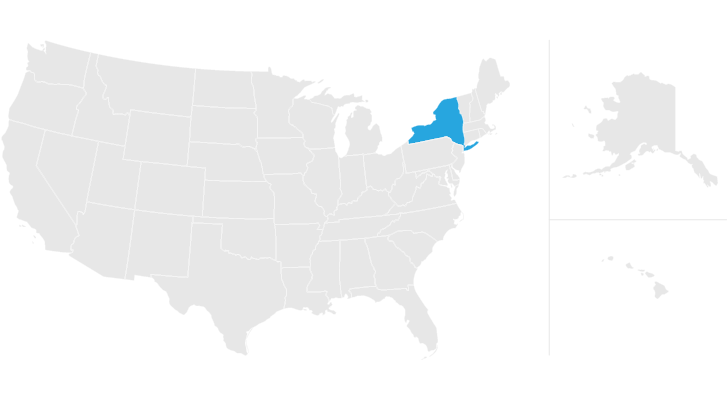
The estate tax rate for New York is graduated, starting at 3.06% and going up to 16%. The taxable estate is the value of the estate above the $7.35 million exemption (unless the estate reaches that cliff of 105% of $7.35 million, in which case the whole estate is taxable).
Here’s how to figure out what you’ll be paying: First, figure out what your taxable estate is. If your total estate is worth less than $7,518,000, the taxable estate is the total amount minus $7.35 million.
Next, find your taxable estate bracket in the chart below. The base taxes amount in the second column is what you owe on money that falls below your tax bracket. You’ll then need to figure out by how much your estate exceeds the lower limit of your bracket. Multiply that number by the marginal rate. Add that amount to your base, and you should know what you owe.
New York Estate Tax Rates
| Taxable Estate* | Base Taxes Paid | Marginal Rate | Rate Threshold** |
|---|---|---|---|
| $1 – $500,000 | $0 | 3.06% | $1 |
| $500,000 – $1 million | $15,300 | 5.00% | $500,000 |
| $1 million – $1.5 million | $40,300 | 5.50% | $1 million |
| $1.5 million – $2.1 million | $67,800 | 6.50% | $1.5 million |
| $2.1 million – $2.6 million | $106,800 | 8.00% | $2.1 million |
| $2.6 million – $3.1 million | $146,800 | 8.80% | $2.6 million |
| $3.1 million – $3.6 million | $190,800 | 9.60% | $3.1 million |
| $3.6 million – $4.1 million | $238,800 | 10.40% | $3.6 million |
| $4.1 million – $5.1 million | $290,800 | 11.20% | $4.1 million |
| $5.1 million – $6.1 million | $402,800 | 12.00% | $5.1 million |
| $6.1 million – $7.1 million | $522,800 | 12.80% | $6.1 million |
| $7.1 million – $8.1 million | $650,800 | 13.6% | $7.1 million |
| $8.1 million – $9.1 million | $786,800 | 14.40% | $8.1 million |
| $9.1 million – $10.1 million | $930,800 | 15.20% | $9.1 million |
| Over $10.1 million | $1.082 million | 16.00% | $10.1 million |
*The taxable estate is the amount above the 2026 exemption of $7.35 million.
**The rate threshold is the point at which the marginal estate tax rate goes into effect.
Example New York Estate Tax Calculation
Let’s say your total estate is worth $8 million. That exceeds the $7,717,500 cliff, so all of it is taxable.
Next, we find where that number falls on the chart. The base tax for the bracket is $650,800. The bottom of the threshold is $7.1 million, so we subtract that from $8 million and get $900,000. That amount multiplied by the marginal rate of 13.6% is $122,400. When we add that number to the base tax, we get a total tax of $773,200 on an $8 million estate.
What Is the Estate Tax?
Estate tax is a tax levied on the estate of a deceased person prior to its dispersal to heirs. You may have heard it referred to as the “death tax.” It does not apply to all estates, only those that reach a certain threshold of value, and that value differs from state to state.
People can confuse estate tax with inheritance tax, but these are two distinct taxes. Inheritance tax is paid after the estate is dispersed by the person who received the money. In contrast, the government takes estate tax from the estate of the deceased before the heirs receive it.
New York Inheritance Tax
There is no inheritance tax in New York. If you’re getting money from a relative, you don’t have to give any of it to New York state. If the person who died lived in another state, though, make sure to check that state’s inheritance tax rules in case they apply to you.
For example, Pennsylvania has an inheritance tax that may apply to you if the person leaving you an inheritance lived there.
New York Gift Tax
New York does not currently have a gift tax. If someone wants to avoid their estate having to pay high taxes, they can give away money as gifts before they die. One important caveat, though: Gifts that a person makes within three years before their death do count toward establishing a person’s estate total. This means you can’t give all of your money to someone on your deathbed to avoid paying taxes.
The federal gift tax exemption is $19,000 per recipient for 2026, the same as it was for 2025. Any gift to a single person in one year that exceeds that amount will count against your 2026 lifetime exemption of $15 million.
New York Estate Tax for Married Couples
When someone dies, money that goes to their spouse is not subject to the estate tax in New York or at the federal level (more on this in the section below). When the second spouse dies, any amount of the estate exceeding $7.35 million will be subject to normal New York estate tax rules. In other words, the New York estate tax exemption is not portable between spouses.
Some couples will try to partially get around this by establishing a trust equal to the estate tax exemption and exposing it to the estate tax upon the first spouse’s death. With this arrangement, money won’t be taxed when the second spouse dies.
Federal Estate Tax

There is also a federal estate tax. The federal estate tax kicks in at $15 million in 2026. On the federal level, the estate tax exemption is portable between spouses. This means that with the right legal steps, it’s possible to for a married couple to double their estate exemption when the second spouse dies. This would allow a couple to protect up to $30 million of their estate from federal estate taxes in 2026.
For those estates that still exceed this amount, the tax rate tops out at 40%. The chart below has the full list of graduated tax rates.
You can use the same process described above in the New York Estate Tax section to figure out your federal estate tax burden.
Federal Estate Tax Rates
| Taxable Estate* | Base Taxes Paid | Marginal Rate | Rate Threshold** |
|---|---|---|---|
| $1 – $10,000 | $0 | 18% | $1 |
| $10,000 – $20,000 | $1,800 | 20% | $10,000 |
| $20,000 – $40,000 | $3,800 | 22% | $20,000 |
| $40,000 – $60,000 | $8,200 | 24% | $40,000 |
| $60,000 – $80,000 | $13,000 | 26% | $60,000 |
| $80,000 – $100,000 | $18,200 | 28% | $80,000 |
| $100,000 – $150,000 | $23,800 | 30% | $100,000 |
| $150,000 – $250,000 | $38,800 | 32% | $150,000 |
| $250,000 – $500,000 | $70,800 | 34% | $250,000 |
| $500,000 – $750,000 | $155,800 | 37% | $500,000 |
| $750,000 – $1,000,000 | $248,300 | 39% | $750,000 |
| Over $1,000,000 | $345,800 | 40% | $1,000,000 |
*The taxable estate is the total above the 2026 exemption of $15 million.
**The rate threshold is the point at which the marginal estate tax rate kicks in.
Overall New York Tax Picture
New York is a moderately tax-friendly state for retirees. It does not tax Social Security. New York income tax rates range from 4% to 10.9%. Money from pensions or other retirement accounts are deductible up to a certain amount.
New York City also collects its own local income taxes. If you live within the five boroughs, keep that in mind. You can see what your take home pay is with taxes factored in using SmartAsset’s New York paycheck calculator.
The overall effective property tax rate in New York is 1.45%. The state sales tax rate is 4%. However, this can get as high as almost 9% in certain areas, after accounting for various county and city rates.
How a Financial Advisor Can Help With New York Estate Tax Planning
New York’s estate tax cliff and lack of spousal portability create planning challenges that go well beyond simply knowing the $7.35 million exemption. A financial advisor working alongside an estate planning attorney can help you navigate these specific New York rules and reduce what your estate ultimately owes.
Avoiding the New York Estate Tax Cliff
- What an advisor can do: An advisor can monitor your estate’s value relative to the 105% cliff threshold and identify strategies to keep the estate either comfortably below the exemption or, if above it, far enough below the cliff that only the excess is taxed rather than the entire estate.
- Example: A retiree in Westchester has an estate valued at $7.6 million, putting it within the cliff range above the $7.35 million exemption but below $7,717,500. An advisor identifies that a modest reduction through lifetime gifting could bring the estate back under the exemption entirely. This would allow them to avoid tax altogether rather than risking a future valuation that crosses the cliff and exposes the full estate to tax.
Structuring Trusts to Preserve Both Spouses’ Exemptions
- What an advisor can do: An advisor can work with an estate planning attorney to establish a trust structure, often called a credit shelter or bypass trust. This uses the first spouse’s exemption at death rather than allowing it to go unused, since New York’s exemption is not portable between spouses.
- Example: A married couple in Long Island has a combined estate of $12 million. Without planning, only one spouse’s $7.35 million exemption would apply when the second spouse dies, exposing roughly $4.65 million to New York estate tax. An advisor helps establish a trust funded with the first spouse’s exemption amount, preserving both exemptions and reducing the taxable estate by millions.
Coordinating Lifetime Gifting Within New York’s Three-Year Lookback
- What an advisor can do: An advisor can help you plan gifts using the federal annual exclusion while accounting for New York’s rule that gifts made within three years of death are added back into the taxable estate, ensuring gifting strategies are started early enough to be effective.
- Example: A business owner in Buffalo with an $8.5 million estate wants to reduce their exposure to New York’s estate tax cliff through gifting. An advisor builds a multi-year gifting plan starting well in advance, since any gifts made within three years of death would be pulled back into the estate and could push the estate back over the cliff threshold.
Modeling Combined New York and Federal Estate Tax Exposure
- What an advisor can do: An advisor can calculate how an estate is taxed at both the New York and federal level simultaneously. An estate well above the New York threshold may still fall below the $15 million federal exemption, requiring separate strategies for each.
- Example: A retiree in Manhattan has an estate worth $9 million. An advisor calculates that while no federal estate tax applies, the estate will owe New York estate tax on the amount above $7.35 million. The advisor presents charitable giving and trust options specifically targeted at reducing the New York liability without unnecessarily restructuring assets to address a federal tax that does not yet apply.
Reviewing the Plan as the Exemption and Asset Values Change
- What an advisor can do: An advisor can track how the New York exemption adjusts annually for inflation alongside your estate’s growth, flagging when a previously safe estate value is approaching the threshold or cliff range.
- Example: A homeowner in Albany has an estate valued at $6.8 million, comfortably below the 2026 exemption of $7.35 million. An advisor conducting an annual review notes that continued real estate appreciation could push the estate close to the exemption within a few years, even as the exemption itself rises with inflation. They recommend monitoring both figures together rather than assuming the current safety margin will hold.
Estate Planning Tips
- If all of this is confusing to you, there are professionals who can help, such as a financial advisor. Finding a financial advisor doesn’t have to be hard. SmartAsset’s free tool matches you with vetted financial advisors who serve your area, and you can interview your advisor matches at no cost to decide which one is right for you. If you’re ready to find an advisor who can help you achieve your financial goals, get started now.
- When writing a will, make sure you name a guardian for your children. It isn’t pleasant to think about, but taking care of the non-financial aspects of your estate allows you to have peace of mind and to focus on other parts of your financial planning.
Photo credit: ©iStock.com/Pgiam, SmartAsset, ©iStock.com/Eloi_Omell
Article Sources
All articles are reviewed and updated by SmartAsset’s fact-checkers for accuracy. Visit our Editorial Policy for more details on our overall journalistic standards.
- Estate Tax. Dec. 3, 2025, https://www.tax.ny.gov/pit/estate/etidx.htm#bea.