 Written by

Oregon has an estate tax, but the good news for beneficiaries is that there is no inheritance tax. The estate tax rate in Oregon ranges from 10% to 16% and applies to estates above $1 million. If you are estate planning in Oregon and your estate is worth more than $1 million, you’ll have to consider the impact of the tax on your estate.
A financial advisor can answer your questions about estate planning or any other long-term goals.
Oregon Estate Tax Exemption
The Oregon estate tax threshold is $1 million. If an estate exceeds that amount Oregon will tax it, but the rate only applies after the first million.
Oregon Estate Tax Rate
Oregon uses a graduated rate for its estate tax. It starts at 10% and goes up to 16%. The taxable estate is the value of the estate above the $1 million exemption.
Here’s how to figure out what your estate will be paying: First, figure out what your taxable estate is. Next, find your taxable estate bracket in the chart below. The base taxes listed in the second column is what you owe on money that falls below your tax bracket. Then figure out by how much your estate exceeds the lower limit of your bracket and multiply that number by the marginal rate. Add that sum to your base taxes and that’s how much you owe in estate taxes.
Here’s an example: Let’s say your total estate is worth $5 million. If we subtract the $1 million exemption, that leaves a taxable estate of $4 million. The base tax for the bracket is $367,500. The bottom of the threshold is $3.5 million, so we subtract that from $4 million and get $500,000. That amount multiplied by the marginal rate of 11.5% is $57,500. When we add that number ($57,500) to the base tax ($367,500), the total Oregon estate tax amounts to $425,000 owed on a $5 million estate.
Oregon Estate Tax Rates
| Taxable Estate* | Base Taxes Paid | Marginal Rate | Rate Threshold** |
|---|---|---|---|
| $0 – $500k | $0 | 10% | $0 |
| $500k – $1.5 million | $50k | 10.25% | $500k |
| $1.5 million – $2.5 million | $152.5k | 10.5% | $1.5 million |
| $2.5 million – $3.5 million | $257.5k | 11% | $2.5 million |
| $3.5 million – $4.5 million | $367.5k | 11.5% | $3.5 million |
| $4.5 million – $5.5 million | $482.5k | 12% | $4.5 million |
| $5.5 million – $6.5 million | $602.5k | 13% | $5.5 million |
| $6.5 million – $7.5 million | $732.5k | 14% | $6.5 million |
| $7.5 million – $8.5 million | $872.5k | 15% | $7.5 million |
| $8.5 million and up | $1.0225 million | 16% | $8.5 million |
*The taxable estate is the amount above the exemption of $1 million. 1
**The rate threshold is the point at which the marginal estate tax rate goes into effect.
What Is the Estate Tax?
Many states, as well as the federal government, charge a tax on the estates of the recently deceased. Governments that have an estate tax generally have an exemption that guarantees that only the estates of the relatively wealthy will end up actually paying the tax. Estate tax is different from the inheritance tax. A person’s heirs pay inheritance tax after they’ve already received their money. However, the estate must pay the estate tax before it distributes any money to heirs.
Oregon Inheritance Tax
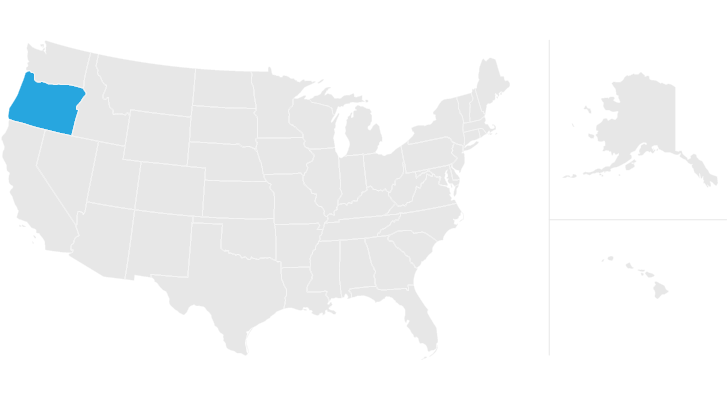
Oregon does not have an inheritance tax. The state’s estate tax used to be called an inheritance tax, but was still an estate tax in practice.
If you’re inheriting property or money from someone who lives out of state, make sure to check local laws. For example, Pennsylvania has an inheritance tax that may apply to you if you’re inheriting from someone who called the Keystone State home even if you live in another state.
Oregon Gift Tax
Oregon does not have a gift tax. The federal gift tax only applies to gifts over $19,000 in 2026. Any gift exceeding this amount to one person in a calendar year counts against your 2026 lifetime exemption of $15 million.
Oregon Estate Tax for Married Couples
The estate tax is not applied when a surviving spouse is inheriting all of a person’s wealth. When the second spouse dies, though, the estate is still only allowed to apply a $1 million exemption for the purpose of the Oregon estate tax. The estate does not get to apply the $1 million exemption for both partners.
Federal Estate Tax
There is also a federal estate tax with an exemption of $15 million in 2026 and $13.99 million in 2025. On the federal level, the estate tax exemption is portable between spouses. With the right legal steps both spouses’ exemptions can apply to their estate, creating a total exemption of $30 million in 2026.
For those estates that still exceed this amount, the tax rate tops out at 40%. The chart below has the full list of graduated tax rates.
You can follow the same process described above in the Oregon Estate Tax section and use the table below to figure out your federal estate tax liability.
Federal Estate Tax Rates
| Taxable Estate* | Base Taxes Paid | Marginal Rate | Rate Threshold** |
|---|---|---|---|
| $1 – $10,000 | $0 | 18% | $1 |
| $10,000 – $20,000 | $1,800 | 20% | $10,000 |
| $20,000 – $40,000 | $3,800 | 22% | $20,000 |
| $40,000 – $60,000 | $8,200 | 24% | $40,000 |
| $60,000 – $80,000 | $13,000 | 26% | $60,000 |
| $80,000 – $100,000 | $18,200 | 28% | $80,000 |
| $100,000 – $150,000 | $23,800 | 30% | $100,000 |
| $150,000 – $250,000 | $38,800 | 32% | $150,000 |
| $250,000 – $500,000 | $70,800 | 34% | $250,000 |
| $500,000 – $750,000 | $155,800 | 37% | $500,000 |
| $750,000 – $1,000,000 | $248,300 | 39% | $750,000 |
| Over $1,000,000 | $345,800 | 40% | $1,000,000 |
*The taxable estate is the total above the 2026 exemption of $15 million. 2
**The rate threshold is the point at which the marginal estate tax rate kicks in.
Overall Oregon Tax Picture
Oregon is moderately-tax friendly for retirees. The state doesn’t tax Social Security, but it fully taxes retirement accounts and partially taxes pensions. Income tax in Oregon is progressive, with a top marginal tax rate of 9.90%. There is no state or local sales tax. The average property tax rate in Oregon is 0.78%, which is below the national average.
You can use SmartAsset’s Oregon paycheck calculator to help you calculate your take home pay in the Beaver State.
How an Advisor Can Help With Estate Planning in Oregon

Oregon’s $1 million estate tax exemption is far lower than the federal threshold, which means estates that would owe nothing federally can still face a state tax bill of 10% to 16%. A financial advisor working alongside an Oregon estate planning attorney can help you assess your exposure and put strategies in place that reduce what your heirs owe.
Assessing Whether Your Estate Crosses the Oregon Threshold
- What an advisor can do: Compile a complete inventory of your assets, including retirement accounts, life insurance proceeds and real estate equity, and project how your estate value may grow over time to determine whether you are likely to owe Oregon estate tax even if you fall well below the federal exemption.
- Example: A retired couple in Portland owns a home worth $650,000, has $400,000 combined in retirement accounts and holds a $150,000 life insurance policy. Individually, neither spouse’s assets would trigger Oregon estate tax, but an advisor reviewing the full picture identifies that the surviving spouse’s estate could exceed $1 million once both estates are combined, prompting a conversation about lifetime gifting and trust planning.
Coordinating Lifetime Gifting to Reduce Taxable Estate Value
- What an advisor can do: Build a gifting plan using the federal annual exclusion to transfer assets without using your lifetime federal exemption, while factoring in how those gifts affect your own retirement income needs and liquidity.
- Example: A business owner in Eugene has an estate valued at $1.3 million, putting them above the Oregon threshold. An advisor models a gifting strategy that transfers shares of a family business to adult children over several years, gradually reducing the taxable estate below $1 million while the owner retains enough liquid assets for retirement spending.
Evaluating Trust Structures for Oregon-Specific Tax Exposure
- What an advisor can do: Work with an estate planning attorney to evaluate trust structures, such as a bypass trust, that preserve both spouses’ exemptions since Oregon’s exemption is not portable between spouses the way the federal exemption can be.
- Example: A married couple in Bend has a combined estate of $1.8 million. Without planning, the full amount would be subject to Oregon estate tax upon the second spouse’s death, since only one $1 million exemption would apply. An advisor recommends a trust structure that allows both exemptions to be used, reducing the taxable estate by up to $1 million.
Projecting Estate Growth and Reviewing the Plan Over Time
- What an advisor can do: Provide periodic projections of estate value and flag when a previously adequate plan needs to be revisited as asset values change.
- Example: A homeowner in Lake Oswego has an estate valued at $850,000, comfortably below the Oregon threshold. Over the next decade, home appreciation and retirement account growth push the estate to $1.1 million. An advisor conducting an annual review identifies the shift and recommends revisiting gifting or trust strategies before the estate crosses further into taxable territory.
Resources for Estate Planning Help
- If you have questions about estate planning or other financial planning issues, you could consider working with a financial advisor. Finding a financial advisor doesn’t have to be hard. SmartAsset’s free tool matches you with vetted financial advisors who serve your area, and you can interview your advisor matches at no cost to decide which one is right for you. If you’re ready to find an advisor who can help you achieve your financial goals, get started now.
- You never know when tragedy might strike and you’ll need someone else to make decisions for you and your estate. You should consider drafting a living will to make sure everything will be taken care of the way you want it to be.
Photo credit: ©iStock.com/Georgijevic, SmartAsset, ©iStock.com/gustavofrazao
Article Sources
All articles are reviewed and updated by SmartAsset’s fact-checkers for accuracy. Visit our Editorial Policy for more details on our overall journalistic standards.
- https://www.oregon.gov/dor/programs/gov-research/Documents/Oregon%20Estate%20Transfer%20Tax%20Return%20Statistics%20Secured-UA.pdf. Accessed July 3, 2026.
- “Instructions for Form 706 (09/2025) | Internal Revenue Service.” Home, Sept. 1, 2025, https://www.irs.gov/instructions/i706.