 Written by
  Edited by
  Edited by
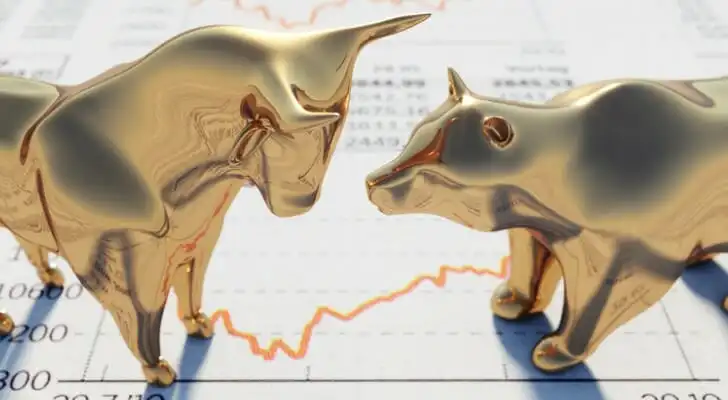
“Bullish” and “bearish” are common terms used to describe how investors feel about the direction of the market. A bullish investor expects prices to rise, while a bearish investor expects prices to fall. These views can apply to the broader stock market, a specific sector or an individual investment. Recognizing the difference between bullish and bearish sentiment can help investors evaluate market conditions, adjust their strategies and manage risk more effectively.
Whether your sentiment is bearish or bullish, one way to manage your investment portfolio is to work with a financial advisor.
What Does It Mean to Be Bullish?
A bullish investor, also known as a bull, believes that the price of one or more securities or indexes will rise. This can apply at any scale of the market. Sometimes a bullish investor believes that the market as a whole is due to go up, foreseeing general gains. In other cases, an investor might anticipate gains in a specific industry, stock, bond, commodity or collectible. If an investor is, say, bullish about ABC Corp., this means they think that a specific company’s shares will climb.
A bull market conveys a related meaning. It exists when the prices – normally the closing prices – of securities or indexes that track a set of securities, typically those of equities, rise. While not every stock will necessarily increase, the market’s main equity indexes will.
For example, during a bull market, the Dow Jones Industrial Average and the S&P 500 can be expected to climb. This holds even if some individual equities and sectors may not. Unlike a bear market, there’s no universally accepted percentage gauge for how much a market has to rise before it qualifies as a bull market. The longest bull market in American history for stocks lasted for 4,494 days and ran from December 1987 to March 2000.
The prevailing sentiment of participants in a bull market is often greed or the fear of missing out.
Where the Term Bullish Comes From
The term bull originally referred to speculative purchases rather than general optimism about prices and trend lines. When the term first came into use, it referred to when someone grabbed a stock, hoping it would increase in value. Later on, the term evolved to refer to the individual making that investment. It then eventually transferred to the general belief that prices will rise.
Etymologists disagree on the exact origin of this term. However, it most likely has its origins as a foil to the term bear. While other theories circulate, this is the most generally accepted source of the phrase bull market. Perhaps the most widely reported alternative source for the term comes from how the bull as an animal attacks, by sweeping its horns upward in the same direction that optimist investors expect the market to go.
By contrast, under this theory, a bear market refers to how a bear will swipe downward with its paw. However, while literature contains numerous positive references to bulls throughout the Western canon, etymologists have found little sound evidence for this specific theory in any historical record.
What Does It Mean to Be Bearish?

A bearish investor, also known as a bear, believes prices will go down. Someone can be bearish about either the market as a whole, individual stocks or specific sectors. Someone who believes ABC Corp.’s stock will soon go down is said to be bearish on that company. An investor who foresees a market-wide dip in stocks, bonds, commodities, currencies or alternative investments like collectibles, is said to be bearish. This is because they anticipate a sustained and significant downturn.
A bear market is one in which the prices of securities in a key market index (like the S&P 500) have been falling for some time by at least 20%. This isn’t a short-term dip like during a correction when there are price declines of 10% to 20%. A bear market is a trend that leaves investors feeling pessimistic about the future outlook of financial markets. A secular bear market is one that lasts for years.
The longest U.S. bear market was 61 months, from March 10, 1937, to April 28, 1942. The most severe bear market chopped 86% of the market’s value; it extended from Sept. 3, 1929, to July 8, 1932. It might be said that the prevailing sentiment of investors who expect a bear market is fear. That fear, specifically, is that a coming downturn will wipe out wealth.
Where the Term Bearish Comes From
The term bear market most likely came from both parable and practice. It generally relates to the trade of bear skins during the 18th century. During this era, fur traders would, on occasion, sell the skin of a bear that they had not yet caught. They did this as an early form of short selling, trading in a commodity they did not own in the hopes that the market price for that commodity would dip. When the time came to deliver on the bearskin, the trader would, theoretically, go out and buy one for less than the original sale price and make a profit off the transaction.
While this worked often enough to keep the practice going, it usually failed. This led to popular expressions of the time. These include “don’t sell the bear’s skin before catching the bear,” “selling the bearskin” and “bearskin jobber.” All of these referred to a warning about speculation and making promises you can’t keep, while a bearskin jobber was a way of calling someone a cheat and a liar. Today’s equivalent would be on the order of “don’t count your chickens before they hatch” and “snake oil salesman.”
But the expressions took on a more specific meaning among investors and stock traders, who understood the practice of speculating on an anticipated downturn. Among investors, the term “bearskin trader” and eventually just “bear trader” came to refer to someone who traded stocks the same way disreputable fur traders dealt in pelts. A “bear” sold a stock he didn’t yet own, in the same way that trappers once sold the pelt of a bear they hadn’t caught. The “bear” then bought the stock back in the hopes of doing so at a lower price and pocketing the difference – in effect a short sale.
Eventually, the term bear expanded. Instead of referring specifically to short sale traders, investors began referring to anyone who expected price dips as bearish, and declining prices as a bear market.
Bullish vs. Bearish: Key Differences
Bullish and bearish describe opposite views about where markets, sectors or individual investments may be headed. A bullish investor expects prices to rise, while a bearish investor expects prices to fall. These terms can apply to the overall stock market, a specific index, a sector, a commodity or a single company’s stock.
| Category | Bullish | Bearish |
|---|---|---|
| Basic meaning | Expecting prices to rise | Expecting prices to fall |
| Investor outlook | Optimistic | Pessimistic or cautious |
| Market direction | Rising prices over time | Falling prices over time |
| Common market example | A broad stock index climbing for an extended period | A broad stock index falling 20% or more from recent highs |
| Typical investor behavior | Buying or holding investments in anticipation of gains | Selling, reducing risk, shorting or moving toward defensive assets |
| Common emotional driver | Confidence or fear of missing out | Fear of losses or economic weakness |
| Potential strategy | Stay invested, add to positions or favor growth assets | Rebalance, raise cash, hedge risk or favor defensive assets |
How to Persevere Through Both Bullish and Bearish Markets
Regardless of the current market we’re in, the standards of strong portfolios remain constant. The first thing you should have in order when it comes to investing is your ultimate financial goals. For most Americans, this principally includes retirement, along with vacations, buying a home and more. By defining your goals, you can make investment decisions based on them.
Once you know your goals and their timeline, you can build your portfolio’s asset allocation. This involves choosing the selection of investments within your portfolio and what percentages they’ll hold. For instance, someone nearing retirement may want to steer clear of individual stocks since they can be quite volatile. Angling towards investments like ETFs and bonds might instead be in order.
On the other hand, if you’re still far from retiring, you might want to take a chance on individual stocks. Their volatility and high-risk nature make their return potential also much stronger. Since it’ll be a while until you retire, you can risk a bit for those earnings.
As your portfolio ages, you shouldn’t just leave it completely alone. Instead, you’ll want to rebalance your investments. This entails bringing your portfolio’s complex back to your intended asset allocation. The necessity for this is derived from returns affecting your portfolio over time.
In the end, there’s no way to ensure gains in the investment market. All you can do is maintain strong investment tendencies and make prudent decisions. In addition, try to avoid trading on emotion, as that can lead you down a dangerous path.
Bottom Line

Bullish and bearish market conditions describe opposite investor expectations. A bullish market reflects rising prices and investor optimism, often supported by strong economic indicators, positive earnings or confidence in future growth. A bearish market reflects falling prices and weaker investor sentiment, which can be driven by economic slowdowns, disappointing earnings or negative market news. Knowing the difference can help investors evaluate market trends, manage risk and avoid making decisions based solely on emotion.
Investing Tips
- Consider talking with a financial advisor who can help you understand if an investment decision or strategy is based on emotions or something more objective. Finding a financial advisor doesn’t have to be hard. SmartAsset’s free tool matches you with vetted financial advisors who serve your area, and you can have a free introductory call with your advisor matches to decide which one you feel is right for you. If you’re ready to find an advisor who can help you achieve your financial goals, get started now.
- One way to handle your portfolio during either a bull or bear market is with a free investment calculator. Such a tool can help limit the role of emotion in your investment decisions.
Photo credit: ©iStock.com/peterschreiber.media, ©iStock.com/DNY59, ©iStock.com/Laurence Dutton