 Written by
  Edited by
  Edited by
  Reviewed by

If you use an IRA to save for retirement, IRS Form 8606 might be an important part of tax season. This is the form where you report nondeductible contributions to a traditional IRA. Beyond that, taxpayers may also use the form to track certain distributions, in addition to conversions from a traditional, SEP or SIMPLE IRA to a Roth IRA.
A financial advisor can help optimize your retirement portfolio to lower your tax liability.
Form 8606: What It Is and When to Complete It
Taxpayers use Form 8606 to report four main transactions:
- Nondeductible contributions to a traditional IRA
- Distributions from a traditional, SEP or SIMPLE IRA when you have basis in traditional IRAs
- Conversions from a traditional, SEP or SIMPLE IRA to a Roth IRA
- Distributions from Roth IRAs when Form 8606 reporting requirements apply
You generally file Form 8606 with your federal income tax return when one of the applicable reporting requirements applies. If you and your spouse both need to file Form 8606, each spouse should file a separate form.
Nondeductible Contributions
When you make a nondeductible contribution to a traditional IRA, you report it using Form 8606. Part I also calculates the taxable and nontaxable portions of applicable traditional IRA distributions when you have basis in your traditional IRAs.
You can make a traditional IRA contribution even when your income or participation in a workplace retirement plan prevents you from deducting some or all of it, as long as you otherwise meet the contribution requirements. Whether a traditional IRA contribution is deductible depends in part on income, filing status and whether you or your spouse has a workplace retirement plan.
For 2026, the IRA contribution limit is $7,500, with an additional $1,100 catch-up contribution for people age 50 and older. Income limits also apply. For a single filer covered by a workplace retirement plan, the deduction phases out with modified adjusted gross income (MAGI) between $81,000 and $91,000. Meanwhile, for married couples filing jointly, the range is $129,000 to $149,000 when the spouse making the contribution is covered by a workplace plan.
If you are not covered by a workplace retirement plan but your spouse is, the deduction phases out between $242,000 and $252,000 for married couples filing jointly in 2026. If neither spouse has a workplace retirement plan, these income-based deduction phase-outs do not apply.
Nondeductible IRA contributions do not provide a tax deduction when you make them. However, investment earnings generally grow tax-deferred while they remain in the traditional IRA. Because the nondeductible contribution has already been taxed, that basis is not taxed again, as long as it’s properly accounted for upon distribution. Earnings and other pretax amounts can still be taxable when withdrawn.
Roth Conversions
If you have converted funds from a traditional, SEP or SIMPLE IRA to a Roth IRA, known as a Roth conversion, you report this using Form 8606. You’ll need to do this whether you converted all of your portfolio or just part of it.
Part II calculates the taxable amount of the conversion. Untaxed amounts converted to the Roth IRA generally become taxable income. Properly documented after-tax basis is not taxed again.
Roth IRA Distributions
Part III of Form 8606 is used to calculate the taxable portion, if any, of certain Roth IRA distributions. A Roth IRA distribution is generally qualified if the applicable five-year period has been satisfied and the distribution is made after age 59 1/2, after death, because of disability or for qualified first-time homebuyer expenses. Qualified distributions are generally tax-free.
The rules for nonqualified Roth IRA distributions depend on what type of money you are withdrawing. Roth IRA ordering rules generally treat regular contributions as coming out first. Next are conversion and rollover amounts, and then earnings. As a result, taking money from a Roth IRA before age 59 1/2 does not automatically mean the entire distribution is taxable or subject to an additional tax.
Form 5329 may also be necessary to determine whether a taxable Roth IRA distribution is subject to the additional tax on early distributions or whether an IRA early withdrawal exception applies.
Early Roth Distributions
Finally, you use Form 8606 to report any distributions taken from a traditional, SEP or SIMPLE Roth IRA before the age 59 1/2 or before the account has been open for five years. This includes distributions taken for disallowed reasons. It also pertains to distributions taken for portfolio exceptions, such as the first-time homebuyer allowance and qualified disaster allowances.
You do not use Form 8606 to report distributions taken from a Roth IRA after the age of 59 1/2 unless the account has not been open for five years.
General Instructions for Completing Form 8606
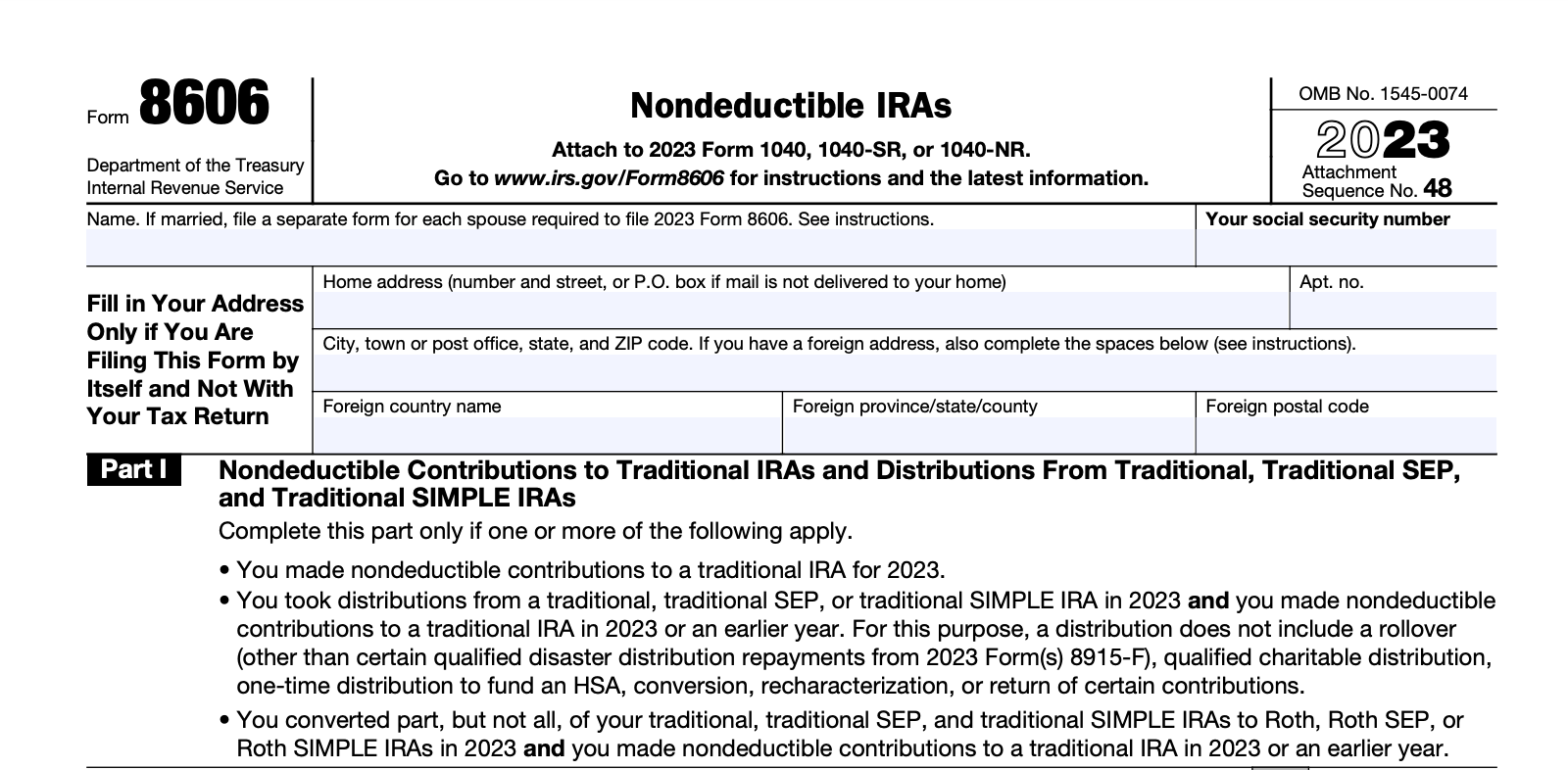
It’s necessary to fill out Part I of Form 8606 if you have nondeductible contributions to a traditional IRA. To complete it, you’ll need to report the amount of nondeductible contributions you’ve made to your traditional IRA for the tax year in Part I. You’ll use that total to calculate the updated basis in your IRA.
The basis of your traditional IRAs generally includes nondeductible contributions and certain other previously taxed amounts, minus any prior nontaxable distributions. Keeping track of this basis is important. It determines how much of a future distribution or conversion is not subject to income tax.
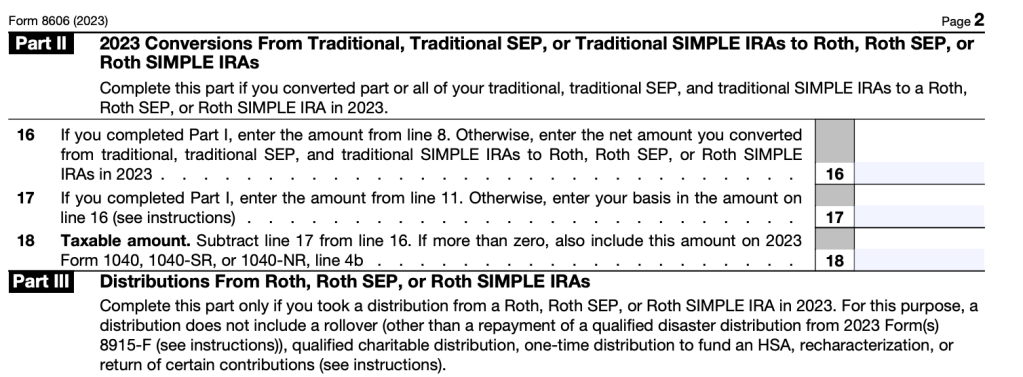
In Parts II and III of Form 8606, you must include amounts for conversions to a Roth account and distributions from a Roth account.
For any conversions to a Roth account for the tax year, you will need to indicate that amount in Part II. If you have basis from nondeductible traditional IRA contributions, Form 8606 determines how much of the conversion is taxable.
If you have a Roth IRA distribution to report, Part III calculates the taxable portion of that distribution.
How the Pro Rata Rule Affects Form 8606
Having nondeductible money in a traditional IRA does not generally allow you to use only that after-tax money for a distribution or Roth conversion. When Form 8606 calculates the taxable portion, your IRA balance is considered collectively. This means traditional, SEP and SIMPLE IRAs are taken into account.
For example, assume your traditional IRAs contain $100,000 at year-end, including $20,000 of after-tax basis. If the applicable Form 8606 calculation determines that 20% of the relevant IRA amount represents basis, the same proportion generally determines the nontaxable share of the distribution or conversion. You cannot simply identify the $20,000 of basis and convert it separately from the pretax money.
This rule is important for taxpayers using nondeductible IRA contributions as part of a Roth conversion strategy. Existing pretax IRA balances can cause part of a conversion to be taxable. This can be the case even when the contribution being converted was made with after-tax money. Form 8606 tracks the remaining basis for use in later years.
Why Keeping Form 8606 Records Matters
Form 8606 can carry information from one tax year to another. If you still have basis in your traditional IRAs after a distribution or conversion, the remaining amount is generally carried forward. You’ll use it when calculating the tax treatment of later transactions.
The IRS instructs taxpayers to keep Forms 8606 and supporting records until all IRA distributions have been made. Records can include Forms 5498 showing contributions and account values and Form 1099-R reporting distributions. Without records of prior nondeductible contributions, it can be harder to establish how much of a future distribution has already been taxed.
Failing to file Form 8606 to report a nondeductible traditional IRA contribution can also carry a penalty. The penalty is $50, unless reasonable cause applies. Overstating nondeductible contributions can result in a $100 penalty.
Bottom Line
Form 8606 is a tax form mainly for reporting nondeductible contributions to an IRA. It also tracks basis in traditional IRAs, calculates the taxable portion of certain traditional IRA distributions and Roth conversions and reports applicable Roth IRA distributions. Keeping copies of the form from year to year can help document after-tax IRA money. This helps ensure that those funds are not taxed again when distributed or converted.
Tax Planning Tips
- A financial advisor can help you build a comprehensive retirement plan. Finding a financial advisor doesn’t have to be hard. SmartAsset’s free tool matches you with vetted financial advisors who serve your area. From there, you can have a free introductory call to decide which one is right for you. If you’re ready to find an advisor who can help you achieve your financial goals, get started now.
- Smart tax filing means smart tax planning. That’s not a small project, though. Here are nine common tax mistakes that could cost you more money. We offer guidance on how to avoid them.
Photo credit: ©iStock/Kemal Yildirim, ©irs.gov, ©irs.gov